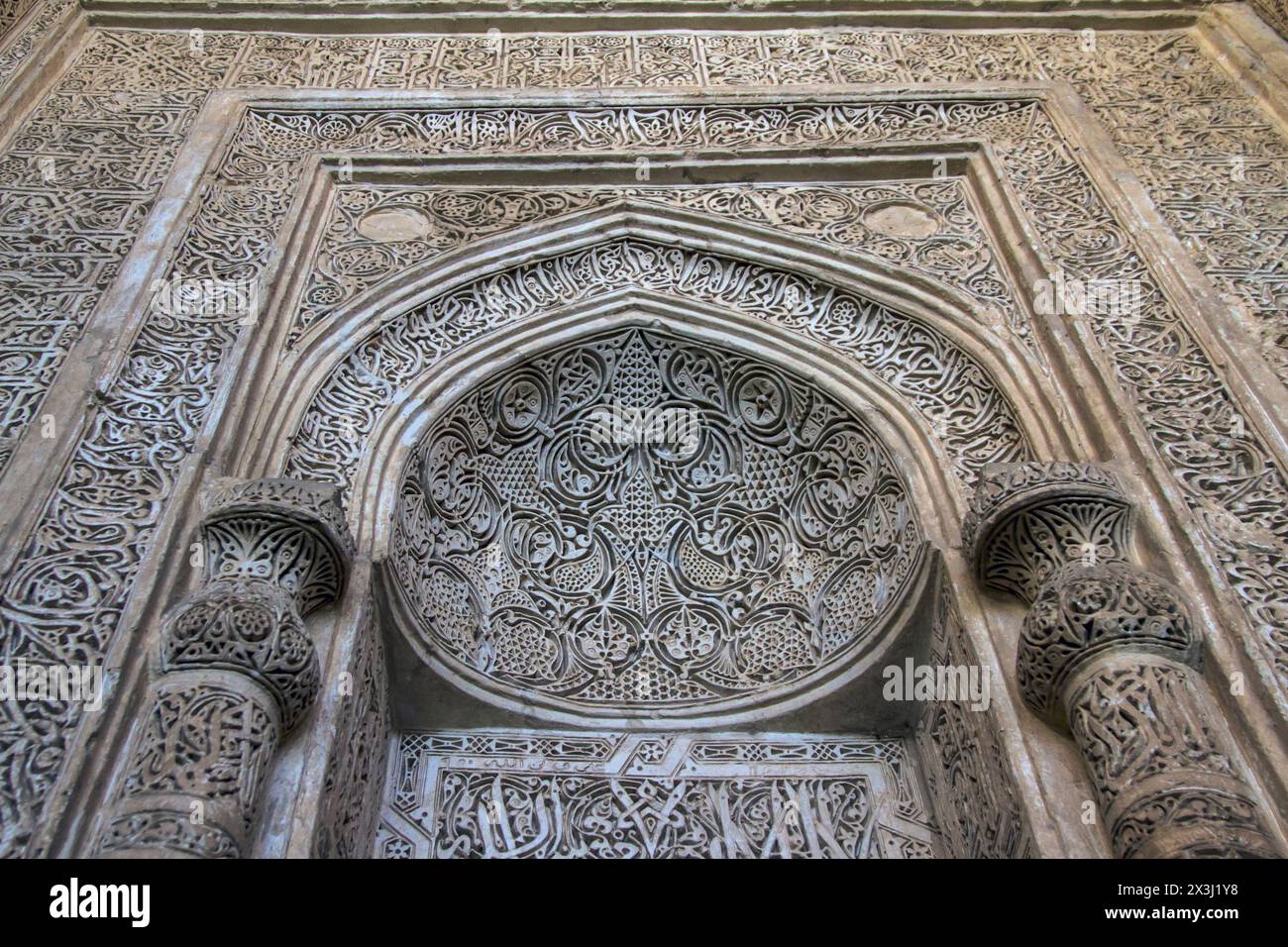
Sheikh Bastami Mosque is a 14th-century religious complex located in downtown Semnan Province, Bastam. It is named after Abu Yazid al-Bastami, better known as Bayazid Bastami, who is buried in that place alongside Muhammad ibn Ja'far al-Sadiq. The complex comprises a mosque, madrasah and the tombs of the aforementioned personalities.
History
Construction on the shrine of Bayazid Bastami is theorised to have predated the Seljuk era, but the oldest inscription extant on the building gives the date of construction as being in the year 1120. During the reign of the Ilkhanid ruler Mahmud Ghazan, the religious complex underwent restoration in 1299. After his death, his successor Öljeitü added an eastern entrance portal and a corridor, as well as an iwan across the courtyard of the mosque. Later on, the Timurid ruler Shah Rukh attached a madrasah to the religious complex.
Architecture
The main iwan leading into the religious complex is formed of a tall arch with a semi-dome of muqarnas, the walls covered with faience and unglazed terracotta. The mosque building is decorated with carved stucco, which dates back to the restoration under Mahmud Ghazan. Several design elements of the mosque building is Seljuk, such as the minaret and one of the walls. The minaret is 20 metres tall. This mosque also has two shabestan, the larger one is used for men and the smaller one is used for women.
The tomb of Bayazid Bastami is located directly next to one of the walls of the complex, in the courtyard. It is a simple structure and is not lavish at all, possibly to reflect the piety and asceticsm of the entombed saint.
The tomb of Muhammad ibn Ja'far al-Sadiq is located on the southern side of the religious complex. It has a conical dome over it, and the tomb is located under the dome. The tomb is sometimes known as an Imamzadeh.
See also
- List of mosques in Iran
- Imamzadeh
- Bayazid Bastami
- Muhammad ibn Ja'far al-Sadiq
References